EN
EN


UVC LED Tube Solutions:
275nm vs. 265nm + 365nm
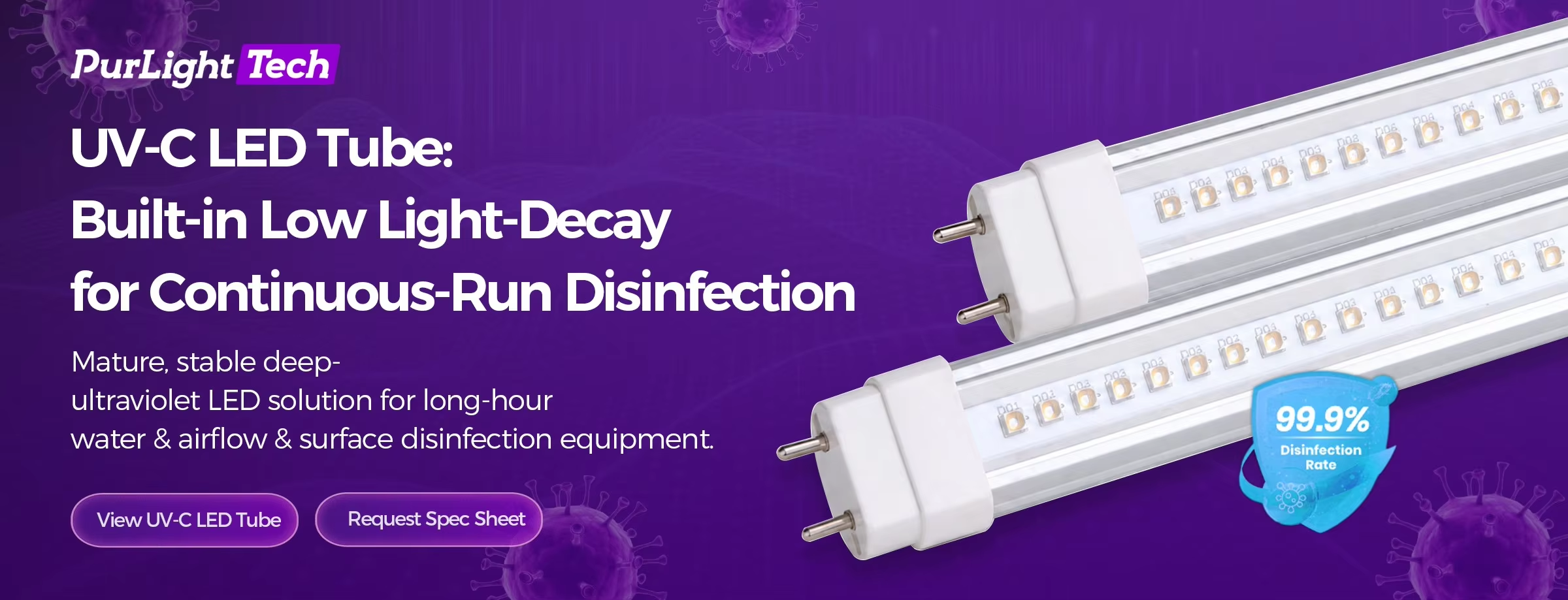
For OEMs building long-hour disinfection equipment, PurLight Tech pairs mature, stable deep-ultraviolet LED sources with built-in low light-decay performance, so output stays consistent shift after shift in air handling and surface disinfection systems alike. This guide walks equipment manufacturers, integrators, and distributors through the two core tube platforms — and shows how each maps to a real deployment profile.
01The OEM Question: One Wavelength Cannot Do Every Job
Deep-UV disinfection is not a single spec. The right tube depends on what you are treating — moving air or surfaces — and how long the equipment must run each day. PurLight Tech's approach is deliberately modular:
Selecting between them is a matter of duty cycle and air-quality requirements, not product quality.
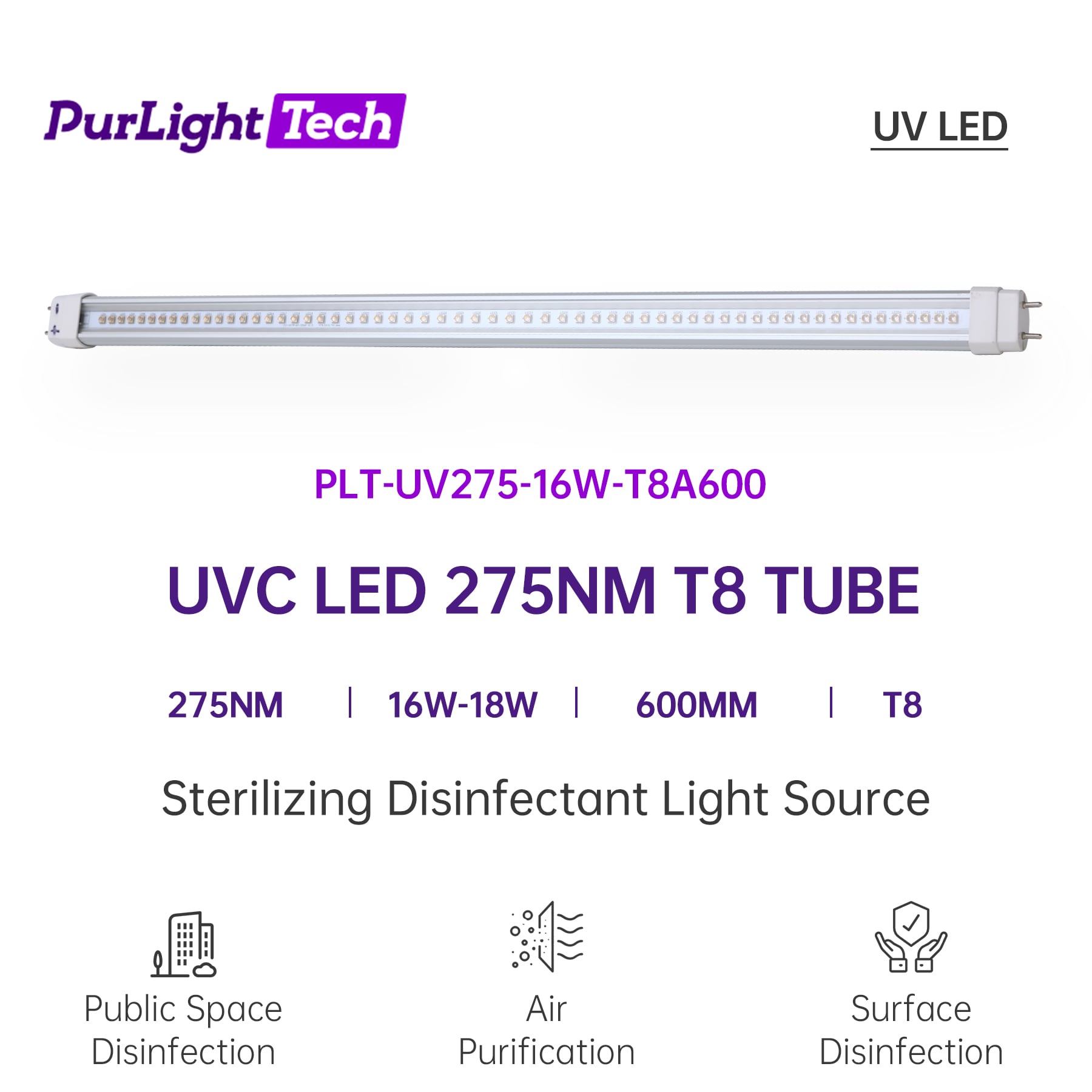
02Solution 1 — 275nm UVC LED Tube (T8 Series, 450mm / 600mm)
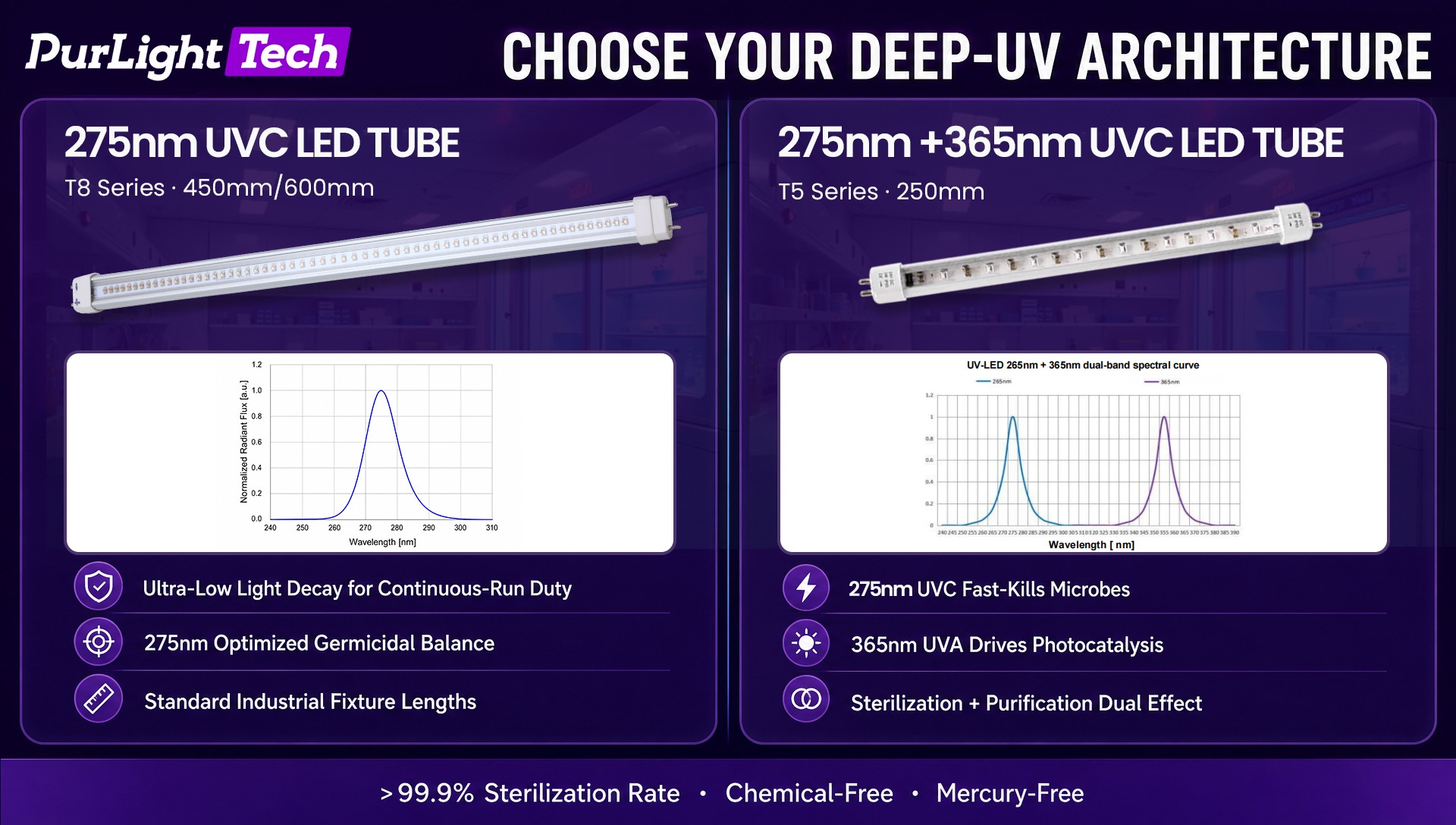
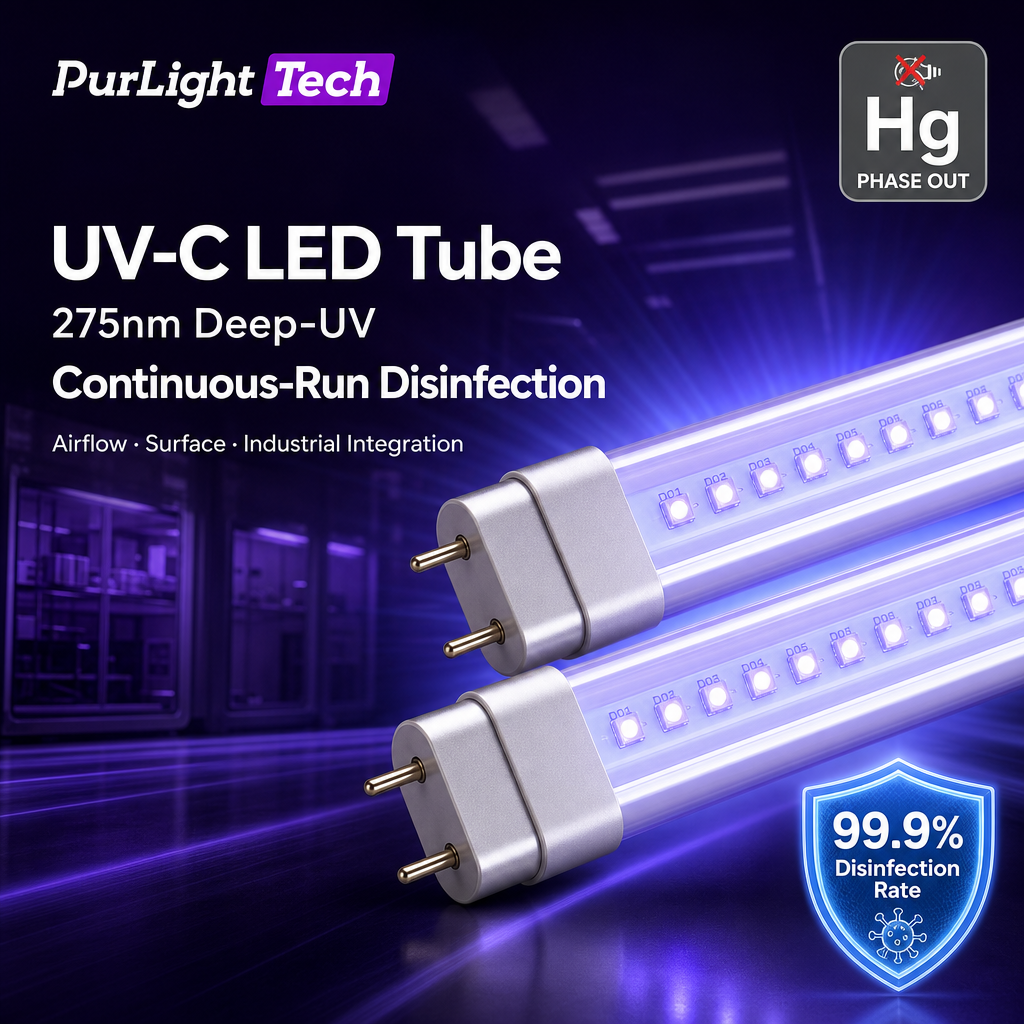
Every T8 model is built around the same 275nm optimized deep-UV wavelength, which balances high disinfection efficiency with ultra-low light decay — the difference is the package. T8 450mm and T8 600mm lengths drop into standard industrial fixtures and longer treatment chambers, so equipment builders can size the light engine to cavity geometry without redesigning the driver architecture around a second wavelength.
Where it performs best:
- Airflow treatment — AHU and duct-mounted modules treating air at the source.
- Surface disinfection equipment — conveyor tunnels, pass-through chambers, and robotic or fixed-array surface systems that cycle all day.
The built-in low light-decay design matters most here: UV LED output naturally degrades with operating hours, and a tube engineered for a flatter decay curve keeps dosing consistent across the equipment's service life — which is what makes "continuous-run" a defensible selling point for your end customer.
03Solution 2 — 265nm + 365nm Dual-Wavelength Tube (T5 Series, 250mm)
The T5 250mm platform is the answer when the environment needs more than microbe kill. Its dual-wavelength engine works in two stages:
- 265nm UVC targets the germicidal peak region for fast microbe inactivation.
- 365nm UVA activates photocatalytic surfaces to break down odors and airborne pollutants — the VOC and smell burden that pure disinfection does not address.
The compact 250mm form factor suits tight cavities, retrofit enclosures, and equipment where interior space is at a premium — small air purifiers, refrigerator/food-storage disinfection modules, and surface units where odor removal is a purchase criterion.
Choose this platform when your customer's complaint list includes "it disinfects, but it still smells" — cold storage, food retail, restrooms, and indoor spaces where air quality is part of the value proposition.
04Selection Framework: Which Solution for Which Deployment
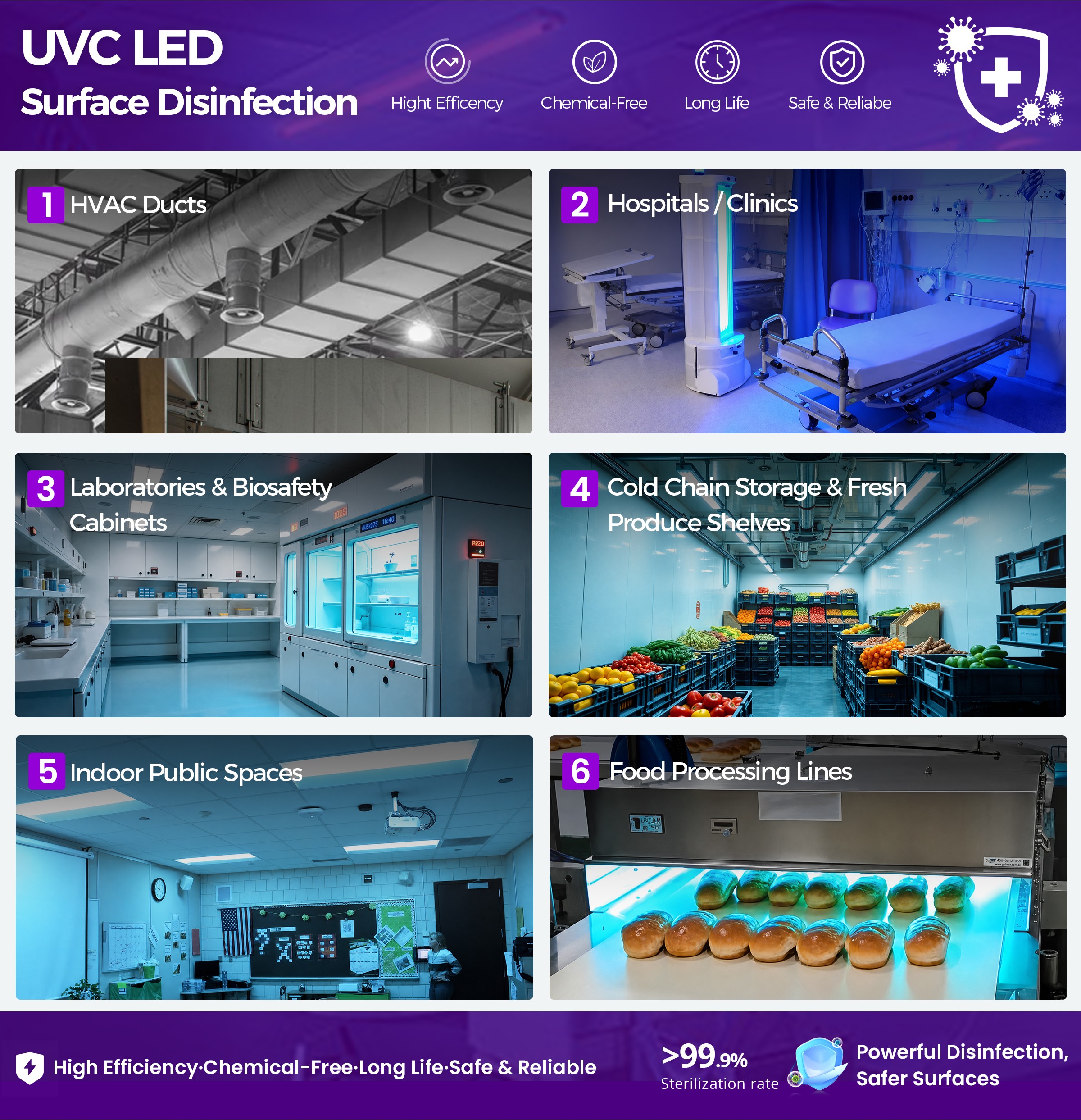
Use the table below as your working reference in RFQ discussions.
| Deployment Profile | Recommended Platform | Why |
|---|---|---|
| HVAC duct / AHU airflow treatment | 275nm T8 (450/600mm) | Long-hour duty; ultra-low decay keeps in-duct dosing stable; standard fixture lengths |
| Food processing conveyor lines | 275nm T8 | Chemical-free surface disinfection over product; residue-free operation |
| Hospitals / clinics surface cycling | 275nm T8 | High-efficiency microbe kill between manual cleaning shifts |
| Laboratories / biosafety cabinets | 275nm T8 (chamber) | Repeatable dosing where chemical fogging is impractical |
| Cold-chain storage & fresh-produce shelving | 265nm + 365nm T5 | Kills microbes and controls ripening odors / ethylene-related smell burden |
| Indoor public spaces (occupied cycles) | 265nm + 365nm T5 | Purification + disinfection where occupants notice air quality |
| Compact retrofit / tight-cavity enclosures | 265nm + 365nm T5 (250mm) | Small footprint; dual function in one module |
05Typical OEM Deployment Patterns
These are recurring project patterns from the brand's application ecosystem — use them as templates when scoping your own customer's equipment.
06What OEMs Should Verify Before Specifying
Duty-Cycle Honesty
Confirm operating hours per day, then ask for the light-decay curve — not just peak output. PurLight's built-in low light-decay design is the spec that protects continuous-run equipment.
Chip-Level Consistency
The platform shows individually labeled LED chips (D01–D0C sequence) across the array — a useful proxy for traceable, machine-placed arrays and batch consistency at production scale.
Cavity Geometry
T8 450mm / 600mm and T5 250mm cover the common envelope range. Choose length by chamber geometry first; wavelength strategy second.
Compliance Posture
Mercury-free UV LED avoids mercury inventory, handling, and disposal obligations that legacy UV-C lamps impose on your finished equipment. Confirm the regulatory paperwork for your target market.
The clean way to spec UV disinfection is to stop asking "which UVC tube" and start asking "what is the equipment doing." Continuous-run airflow and surface systems belong on the 275nm T8 platform — one wavelength, flat decay, standard lengths.
Environments that must also smell clean — cold chain, food retail, occupied spaces, tight retrofits — belong on the 265nm + 365nm T5 platform, where sterilization and purification run in a single module.
Request the spec sheet, review the decay curve against your duty cycle, and build the disinfection story your customers can defend.